Using Placeholders to customize your posts
Table of Contents
A Placeholder (or Dynamic Field) is string of characters that can be used to substitute in unique data. In our the Post Builder, a Placeholder can be used to insert unique location details or custom field data.
You can use placeholders in any field of your location's posts (e.g. in the title, the content field, the link, etc.).
When using a placeholder, make sure the placeholder and value do not exceed the character limit of the field.
Which Placeholders are available?
-
*|name|*= Name of the location -
*|zip|*= Postal or Zip code of the location -
*|city|*= City name of the location. -
*|phone|*= Phone Number of the location -
*|website|*= Website of the location -
*|email|*= Email of the location -
*|street|*= Street address off the location
Important
- Google does not allow post content to include a phone number.When posting to Google, ensure your post follows the Google Posts Content Policy. To learn more about the updated policies, click here.
- LinkedIn does not support the use of any Placeholders. Posts to other social channels that contain Placeholders should be published separately.
Why use Placeholders?
Placeholders make it easy for marketers to populate unique location data when creating content for multiple locations at one time. In context, this means that truly localized content can be created in one publication, rather than creating a single post for each location.
Sample Use Case
I want to create a post for five (5) locations that connects the community with their location and directs customers to visit the local page for each location to learn more.
❌ Without Placeholders, the post across all five locations might look something like the following:
Your local Cafe de Coffee is bringing in summer with a new iced summer brew that is sure to start your day off right. Visit cafedecoffe.com/store for more details about locations near you.
✅ With Placeholders, the post can be more localized like the following:
Hey
*|city|*, Cafe de Coffee is bringing in summer with a new iced summer brew that is sure to start your day off right. Visit*|website|*for more details.
Using the Placeholders produces unique copy since it inserts the unique location data value for each location. The final output when published for all 5 locations will look like the following:
-
Hey
Los Angeles, Cafe de Coffee is bringing in summer with a new iced summer brew that is sure to start your day off right. Visitcafedecoffee.com/store/los-angelesfor more details. -
Hey
New York, Cafe de Coffee is bringing in summer with a new iced summer brew that is sure to start your day off right. Visitcafedecoffee.com/store/new-yorkfor more details. -
Hey
Berlin, Cafe de Coffee is bringing in summer with a new iced summer brew that is sure to start your day off right. Visitcafedecoffee.com/store/berlinfor more details. -
Hey
Helsinki, Cafe de Coffee is bringing in summer with a new iced summer brew that is sure to start your day off right. Visitcafedecoffee.com/store/helsinkifor more details. -
Hey
Paris, Cafe de Coffee is bringing in summer with a new iced summer brew that is sure to start your day off right. Visitcafedecoffee.com/store/parisfor more details.
Using Custom Fields
It is also possible to use custom fields as dynamic placeholders. Custom Field data can be managed in the each location's profile.
A custom field that contains a url can be used in the CTA link in your social post (i.e. appointment links)

This way each local post will contain unique location-specific content (i.e. *|coupon|*, *|discount|*)
What will happen if I use them?
The corresponding values from the profiles of each location will be displayed on the different post.
Is there any example?
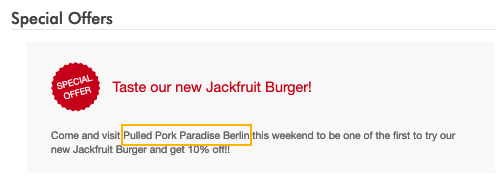
Yes, you can see below a few screenshots from a test account:
- How it looks like in Publish when creating a post:

Examples of the result post in the directories:
- Facebook:
.png)
- ABC Local:
Placeholders can also be used in your location's descriptions. For more information check this article.